The Green Witch’s Pocket Eye: From Dusty Field Guides to Instant Plant ID
This post contains affiliate-style links to some of my favourite tools. If you choose to explore them, you’re supporting the magic here at Moonatic, but I only ever recommend apps and tools I actually use while wandering my own fields with dirt under my fingernails.
Bridging the gap between the ancient herbalists intuition and the smartphone in your palm
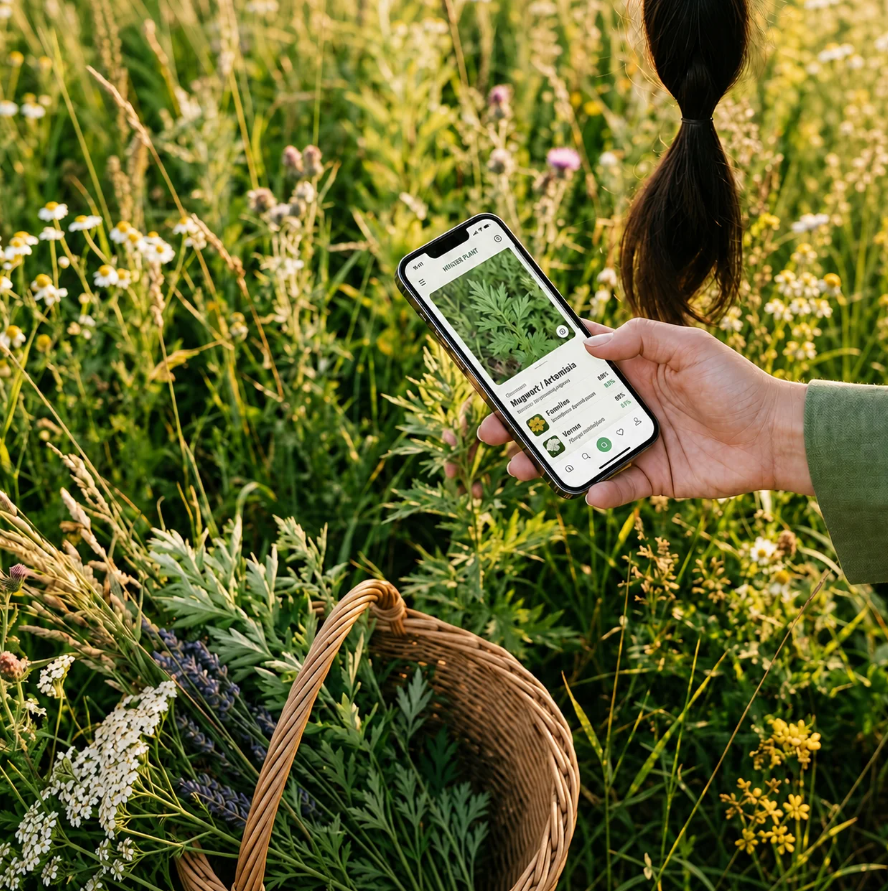
I remember my first “plant identification” mission with the clarity of a particularly vivid dream—or perhaps a particularly persistent nightmare. It was almost two decades ago after moving to Provence, France, and I was armed with a botanical guide that weighed roughly as much as a small toddler and a determination to find mugwort. I spent three hours in a ditch squinting at line drawings of serrated leaves and cross-referencing Latin descriptions that read like ancient riddles. My husband, ever the helpful physicist, stood at the top of the embankment with a thermos of tea and suggested that if I couldn’t find the plant, perhaps the plant didn’t want to be found.
I eventually returned home with a handful of what turned out to be common ragwort and a very mild case of nettle-rash. For the traditionalists among us, there is a romantic, almost hallowed quality to those hours spent thumbing through coffee-stained guides, learning the specific curve of a stem or the exact shade of a petal. It was a rite of passage, a way of training the “herbalists eye” through sheer, stubborn repetition. We were healers-in-training, walking the same paths as the midwives and wise women who had come before us, though they presumably didn’t have to deal with soggy Gore-Tex boots.
But today, my foraging expeditions look a little different. While I still have a bookshelf groaning under the weight of the Encyclopedia of Herbal Medicine, my pocket now contains a tool that would have seemed like sheer sorcery to a medieval apothecary. My smartphone has become my “digital eye,” a lens that can bridge the centuries-old gap between a mysterious weed and its hidden medicinal history in less time than it takes to lace up those same muddy boots. And you know what? That’s perfectly okay.
Developing Your Digital Sight
The transition from “manual” plant ID to digital assistance isn’t about replacing our intuition; it’s about amplifying it. In the past, becoming a proficient green witch required a decade of apprenticeship or a near-monastic devotion to field work. Today, we can use technology to collapse that learning curve, allowing us to spend less time in a state of confusion in a ditch and more time actually connecting with the plant spirits.
I once tried to explain to my mother in law that my phone could “see” the difference between Meadowsweet and Queen Anne’s Lace. She looked at me as if I’d suggested I could fly to the moon on a broomstick, then quietly asked if the phone could also tell her where she’d left her spectacles.
When we use identification apps, we aren’t just getting a name; we are getting a gateway to a plant’s lineage. For the modern witch, identifying a plant is the first step in a ritual of recognition. Once you know its name, you can find its history, its planetary ruler, and its traditional uses in the kitchen and the apothecary.
The Modern Apothecary’s Toolkit
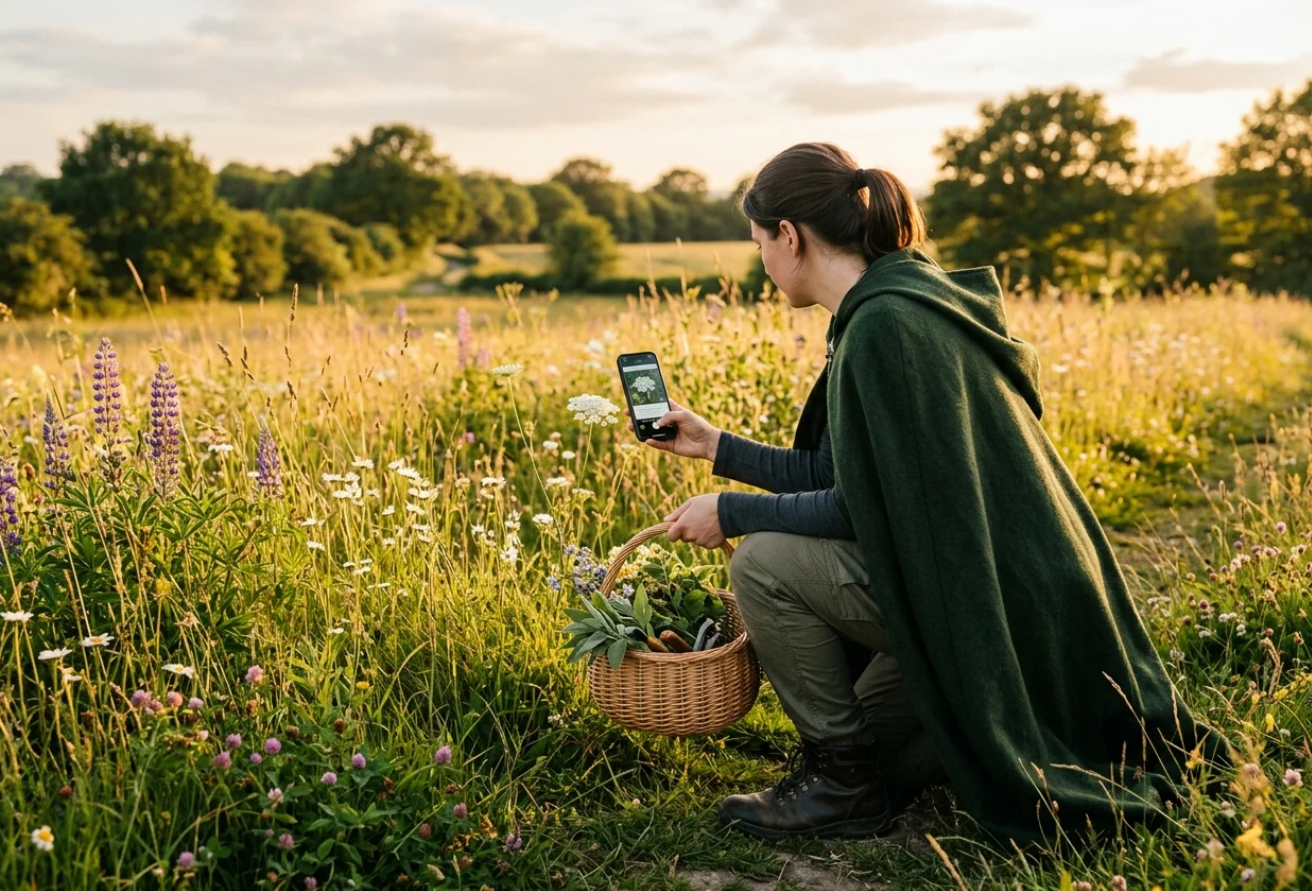
If you are just beginning your journey into the world of green magic, the sheer number of plant ID apps can be overwhelming. Here are my personal recommendations for tools that bridge the gap between scientific accuracy and practical witchcraft:
PlantNet: This is often my first port of call. It is a citizen-science project that uses a massive database of images to identify plants. It’s particularly good because it doesn’t just give you one answer; it shows you several possibilities with percentage rankings, forcing you to use your own eyes to make the final call.
PictureThis: For those who want speed and a very high level of accuracy, this is a powerhouse. It’s incredibly intuitive—you just point and click—and it often provides detailed care instructions and “health checks” for garden plants. It does have a paid tier, but for a busy wellness entrepreneur or a gardener, it’s worth its weight in Elderberries.
iNaturalist: If you’re looking for a community-driven experience, this is the one. It’s a joint initiative by the California Academy of Sciences and the National Geographic Society. When you post a photo, real experts (often actual botanists and veteran herbalists) can weigh in to confirm your ID. It’s like having a collective of wise elders in your pocket.
Seek by iNaturalist: This is the “lite” version of iNaturalist, designed to be more gamified and privacy-focused. You don’t need an account to use it, and it gives you “badges” for finding different types of flora and fauna. It’s fantastic for those of us who still feel a bit shy about sharing our muddy-field photography with the world.
LeafSnap: Developed by researchers from the Smithsonian Institution, the University of Maryland, and Columbia University, this app is specifically designed around leaf shape. If you’ve found a plant that isn’t flowering yet, this is often your best bet for a proper identification.
A Necessary Word of Caution
Before we get too carried away with our digital scrying, we must remember the golden rule of the herbalist: Never, ever rely solely on a single app identification for anything you intend to ingest or use topically.
Digital tools are fallible. Shadows, blur, or a particularly eccentric-looking leaf can confuse even the best AI. No app can currently replace the sensory triad of smell, touch, and deep study. Think of these apps as a “second opinion” or a starting point for your research. If you’re planning on making a tincture or a tea, cross-reference your app’s finding with at least two reputable physical books and, ideally, the regional knowledge of a local forager.
I once had an app confidently tell me that a patch of Poison Hemlock was actually cow parsley. While they might look similar to a computer, the “mousy” smell of the hemlock and the purple-splotched stem are warnings that a smartphone can’t yet sniff out. Stay safe, stay wise, and stay alive.
From Search Result to Sacred Bond
The real magic happens after the identification. Once the app tells you that the “weed” in your garden is actually Achillea millefolium (Yarrow), you can begin the work of the modern witch. You can look up its association with the planet Venus, its history as a protector of soldiers, and its incredible ability to slow a bleed.
The app gives you the name, but you provide the relationship. We are using these digital eyes not to distance ourselves from nature, but to see it more clearly. By removing the frustration of the “unknown,” we make space for the “wonder.” We are no longer strangers in our own gardens; we are friends who finally know the names of everyone at the party.
Step Into the Circle
How are you integrating technology into your green practice? Do you have a favourite app that I’ve missed, or are you still a devoted fan of the leather-bound field guide? I’d love to hear about your most memorable (or most muddy) identification triumphs in the comments.
If you want to dive deeper into the world where tradition meets technology, be sure to sign up for our weekly Moonatic newsletter and join our free community in Podia. We’ll be continuing this “Modern Witch” series every Friday, moving from these basic tools into more advanced digital grimoires and AI-assisted herbalism. Until next time, keep your eyes on the leaves and your heart in the earth.