The Algorithmic Altar: AI for Personalised Rituals
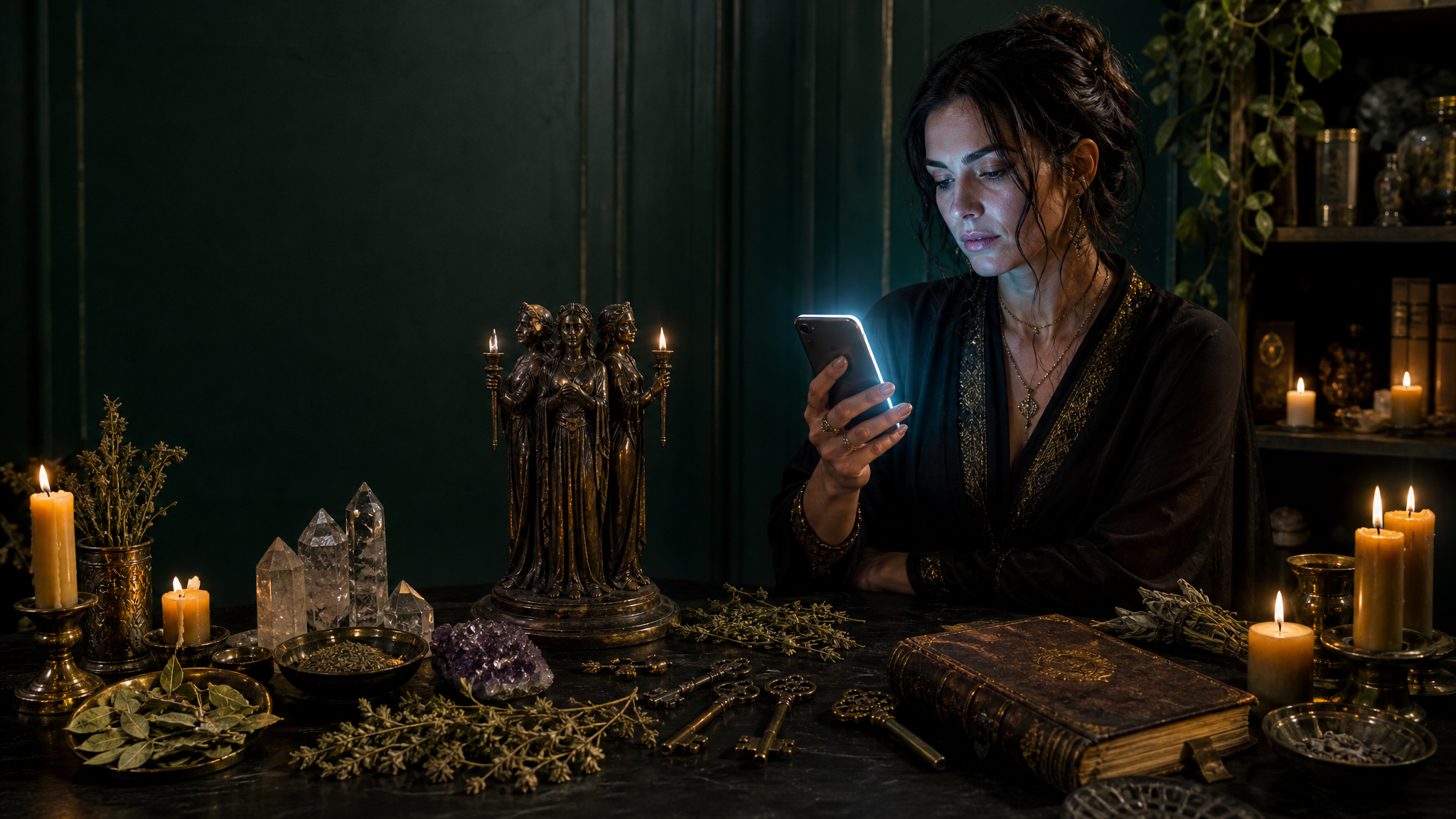
Disclaimer: This post explores the use of digital tools and artificial intelligence to enhance your personal practice. I may receive a small commission if you choose to subscribe to some of the tools mentioned, which helps keep the farm (and my digital grimoire) running.
I remember my first real attempt at a structured ritual when I was eighteen. It involved a lukewarm cup of Earl Grey, a candle that smelled suspiciously of 'ocean breeze', and a massive, leather-bound encyclopedia of correspondences that weighed nearly as much as my teenage angst. I spent three hours cross-referencing Jupiter’s retrograde with the properties of cedar wood and the specific vibrational frequency of amethyst, only to realise I’d forgotten to actually buy the cedar. I ended up waving a dried bay leaf from the kitchen cupboard and hoping the universe wouldn't mind the substitution.
In those days, the "advanced" practitioner was the one with the largest library and the most exhaustive cross-index of herbal properties. We were the keepers of the heavy books, the ones who could recite the moon phases from memory but couldn't find our keys. My husband—a physicist with a PhD and a wonderfully practical soul—still watches me with a mixture of affection and bewilderment when he catches me consulting a lunar app while the kettle boils. "Is the coffee more magical if the moon is in Taurus?" he asks, reaching for his own decidedly non-magical espresso. "No," I tell him, "but I certainly am."
Technology may have changed the tools we use, but it hasn't changed the spirit behind them. We have moved from the whispered incantations of the forest to the weighted vectors of the algorithm, and that’s okay. In fact, for the advanced modern witch, it’s an invitation to precision. We are no longer limited by what we can carry in our pockets or keep on our shelves. We can now use artificial intelligence (AI) to design rituals that are as unique as our own thumbprints.
The Digital Mentor: AI-Powered Craft Guidance
In the past, finding a mentor meant years of searching for a coven or an elder willing to share their lineage. Today, we can find a digital "practitioner" who can help us brainstorm the structure of a ritual in seconds. These tools aren't replacements for tradition, but rather mirrors that reflect our own intentions back to us with a little extra polish.
Wicca: Witchcraft & Spells – This app features an AI Magic Practitioner that acts as a digital mentor. You can ask for ritual suggestions based on specific needs—like a grounding ceremony for a stressful week at the farm—and it provides a structured flow including herbs, crystals, and timing.
Claude / ChatGPT – Using a general-purpose LLM (Large Language Model) is perhaps the most advanced way to customise your practice. By feeding it your personal associations—perhaps you associate lavender with focus rather than sleep—you can have it help you draft a ritual that honours your specific path.
I have found that asking ChatGPT to "write a ritual for a modern herbalist who loves Provence and data science" yields surprisingly poignant results. It once suggested I use the sound of the mistral wind as a cleansing element, which was far more evocative than anything my old encyclopedia ever offered.
The Precision of the Spread: AI-Enhanced Divination
Divination has always been about pattern recognition. Whether we are reading tea leaves or the alignment of the stars, we are looking for the narrative thread that connects our current self to our future potential. Traditional tarot apps have been around for years, but AI takes this a step further by synthesising the cards with your personal data.
Witch – AI Tarot Card Readings – This isn't just a random shuffle. The app uses AI to adapt its interpretations based on your specific questions, zodiac sign, and current intentions. It creates a narrative arc that feels less like a generic horoscope and more like a conversation with your higher self.
Always remember that divination is a tool for reflection, not a predictive certainty. No algorithm can override your own free will or intuition, but it can certainly provide the nudge you need to see a problem from a fresh perspective.
The Biometric Altar: Data-Driven Wellness and Biodynamic Living
This is where the "advanced" part of the modern witch’s toolkit truly shines. For centuries, healers and herbalists have understood that our bodies are deeply connected to the cycles of the earth. On our farm Moonatic Provence, we still try to plant and harvest according to the moon, but I also try to eat and sleep according to my own biological rhythms.
WHOOP / Oura + AI Insights – For the witch who values the "science" in "spiritual science," these wearables use AI to analyse your heart rate variability, sleep quality, and strain. By integrating this with your ritual cycle, you can plan high-energy spellwork when your recovery is high and focus on restorative meditation when the data suggests you’re burnt out.
Ritual Designer GPT – Available in the ChatGPT store, this tool uses a formal design framework (intention, trigger, and flow) developed at Stanford to help you create lasting habits and rituals. It’s perfect for the practitioner who wants to build a rigorous morning routine that incorporates both mindfulness and magical intent.
My physicist husband actually approves of this part. It’s less 'woo' and more 'optimal resource management', which apparently is a language he speaks fluently.
The Soul-Check: A Caveat for the Digital Age
As we embrace these silicon spirits, we must maintain our role as the conductor of the orchestra. An AI can suggest a trigger, a herb, and a sequence of words, but it cannot provide the intention—the vital life force that makes a ritual "magic."
Never rely solely on an AI for herbal safety or spiritual truth. AI models can and do "hallucinate" (a very magical term for a very technical error). Always double-check botanical advice with clinical herbalism sources, and never let an algorithm dictate your moral or spiritual compass. AI is an assistant, not a deity. It creates the map, but you are the one walking the path.
Stepping into the Algorithmic Circle

The healers and wise women of the past used the tools of their time: bone, stone, and the handwritten word. They were innovators who understood that the tool is merely an extension of the hand, and the hand is an extension of the heart. By bringing AI into our practice, we aren't losing the magic; we are expanding its vocabulary. We are finding new ways to listen to the whispers of the universe, now delivered in high-speed data packets.
Whether your altar is built from driftwood and sea glass or pixels and code, the heart of the craft remains the same. It is the intentional act of stopping, listening, and aligning ourselves with something greater than the sum of our parts.
I would love to hear how you are integrating technology into your own practice. Have you used an AI to write a spell? Does your smartwatch help you track your spiritual energy? Step into the circle in the comments below and share your digital magic with us.
If you’d like more insights into the intersection of modern tech and ancient herbs, don't forget to sign up for our newsletter. Every Friday, we bring a bit of Provence (and a bit of data) to your inbox.