The Witch and the Machine: Magic in the Age of AI
Wait! Before we cross the threshold: This post contains affiliate links. If you click through and find a tool that sings to you, I might receive a tiny commission. This keeps my jars of lavender full and my boots from falling apart before the winter rains.
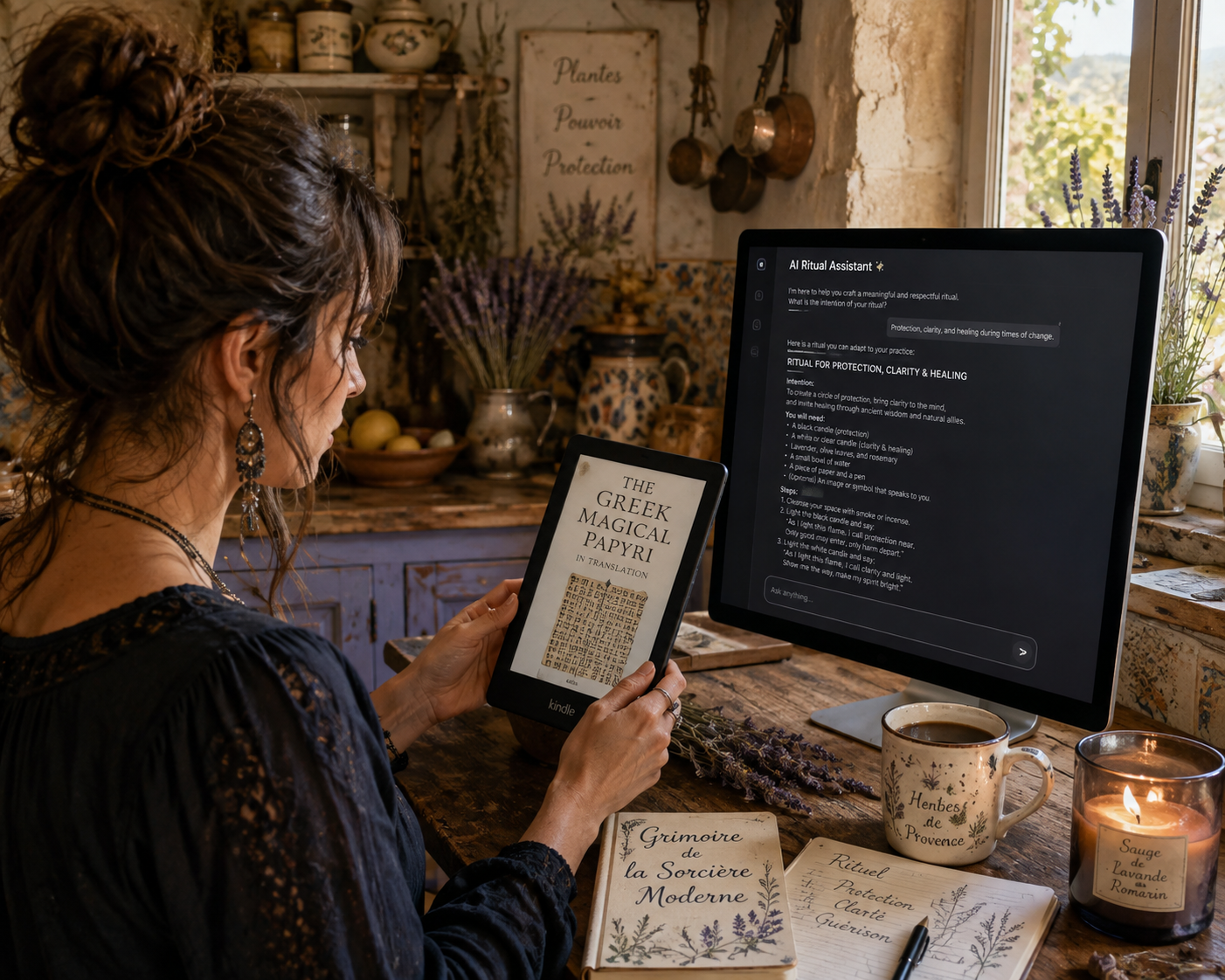
There is a specific kind of silence that only exists in a Provence kitchen at half-past five in the morning, just as the mist is beginning to lift off the lavender fields and the first cicada is tentative in its rhythmic sawing. It’s a silence usually reserved for the brewing of tea and the sharpening of pruning shears. But lately, that silence has been punctuated by the soft, rhythmic clack-clack-clack of my laptop keys, much to the bewilderment of my household.
Maria, my mother in law, is a woman of the earth. She understands the language of soil, the temperament of the wind, and the exact moment a herb is ready to be harvested. She does not, however, understand what I am doing “talking to the machine.” “It is writing a ritual for the Lunar Eclipse in Pisces,” I explained on a Zoom call, while the cursor on the other tab was blinking expectantly.
“The machine?” she asked, her voice a mixture of pity and genuine concern. “The machine knows nothing about Pisces. It knows nothing of the moon. It was made in a factory in a city without stars.”
Just then, my husband, marched through the back door. His muddy boots left a trail of rich, dark earth on the flagstones, a silent testament to her morning’s work in the garden. He leaned over my shoulder, squinting at the screen, his presence smelling of rosemary and damp wool.
“Is this the new ink?” he asked, tapping a weathered finger against the glass. “It’s faster than my father’s quill, but does it have the soul?”
I looked at my muddy boots by the door, then back at the glowing screen. “It doesn’t have the soul, honey. But it’s a very good mirror for mine.”
The Lineage of the Informed: From Scriptorium to Server
We tend to think of the “Modern Witch” as a recent invention, a creature of neon and fiber optics. But the wise women, the cunning folk, and the village herbalists of old were always the masters of information. They were the ones who kept the records of which bark cured the fever and which root warded off the shadows. In the medieval scriptoria, the monks and the healers labored over parchment, their ink made of oak galls and iron, because they knew that memory is a fickle thing. Knowledge, once written, becomes a vessel.
The grimoire was never just a book; it was a living database. It was a place to store the collective wisdom of generations, refined by trial, error, and a dash of divine inspiration. When we use AI—be it ChatGPT or Claude—to help us draft a ritual or organize a herbal monograph, we aren't abandoning tradition; we are stepping into the next iteration of the scribe’s role.
The village healer didn't just know the herbs; she knew how to organize the knowledge of the herbs. She was the bridge between the wild unruliness of nature and the practical needs of the community. Today, our "wildness" is also informational. We are drowning in data, in PDFs of old herbals, in conflicting opinions on planetary hours. AI acts as a sophisticated digital alchemy, distilling the vast, chaotic roar of the internet into something we can actually use at our altars.
I tried to explain the concept of 'prompt engineering' to my neighbour while he was pruning the trees. I told him it was like asking the forest for a specific branch—you have to speak the right language. He looked at me, sighed, and said he preferred to just ask the tree. I suppose when you've lived in the same valley for sixty years, the trees are on a first-name basis with you. For the rest of us, sometimes we need a translator.
The digital Familiars: Tools for the Modern Scribe
Selecting a digital partner for your magical work is a bit like choosing a familiar. You want something that resonates with your frequency, something that can handle the heavy lifting without treading on your toes. Here are the tools I find myself returning to again and again:
ChatGPT (GPT-4o): The polymath of the digital world. It is exceptional for broad organizational tasks—like taking a messy pile of handwritten notes about mugwort and turning them into a structured monograph. I use it to brainstorm structural "bones" for rituals, asking it to give me the correspondences for a particular intention, which I then flesh out with my own heart-work.
Claude (Anthropic): Claude has a more nuanced, "human" prose style than ChatGPT. If I'm struggling to find the right words for an invocation that doesn't sound like a greeting card, Claude is the one I turn to. It’s better at grasping subtext and poetic cadence.
Jasper: While primarily a marketing tool, Jasper has specialized "recipes" that can be adapted for long-form writing. It’s excellent if you’re building a larger project, like a course or a published book, and need to maintain a very consistent brand voice across many documents.
Perplexity AI: Think of this as your research assistant in the Great Library. If you need to find the historical use of vervain in 17th-century Brittany, Perplexity will find the sources and cite them. It’s less about "writing" and more about "finding," which is crucial for those of us who value accuracy in our herbalism.
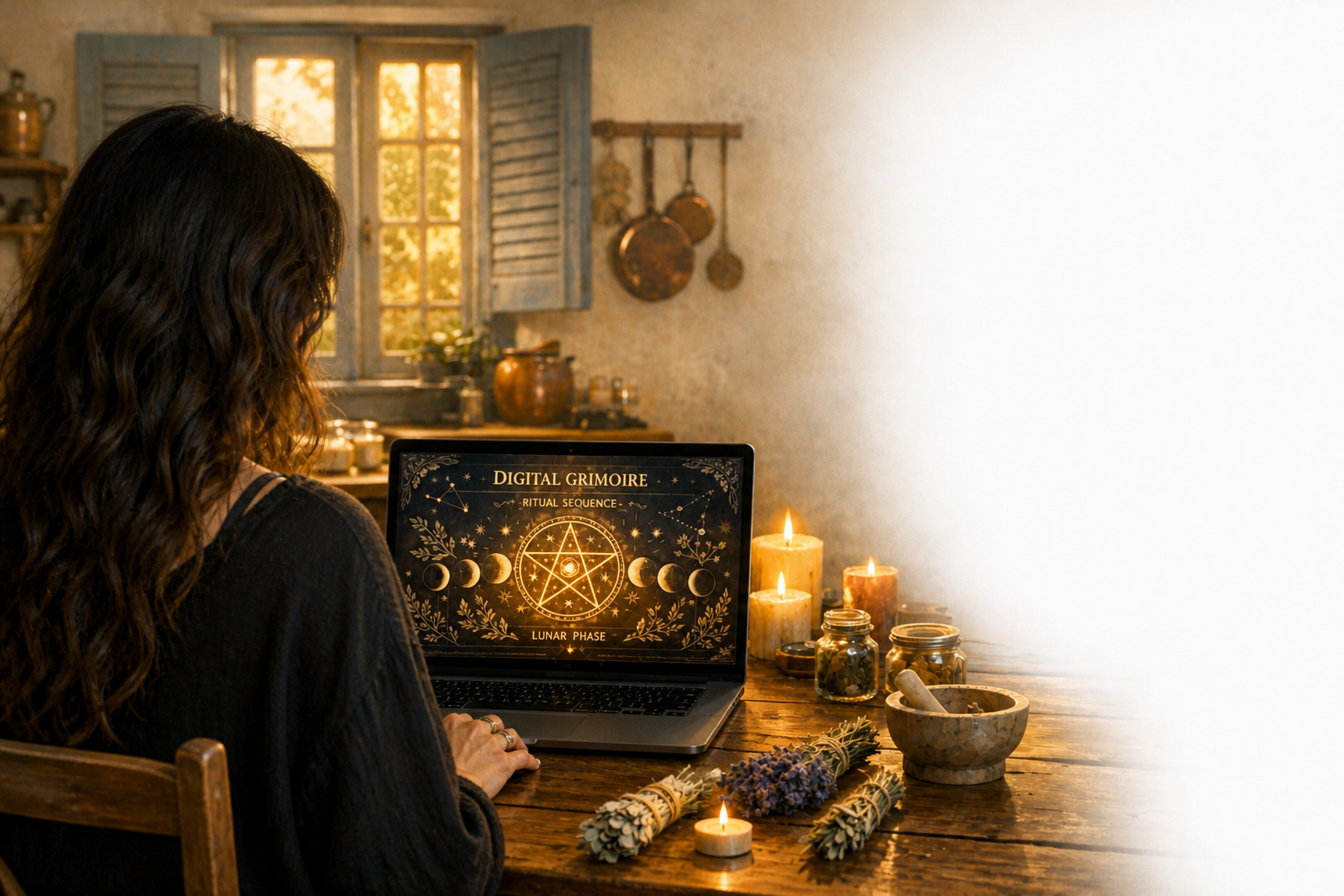
Abacus AI: your living, adaptive grimoire, exists as your daily digital equivalent: an interactive, ever-ready repository for your magical operations.
A Necessary Word of Caution: The Map is Not the Territory
Here is the thing about our silicon sisters: they are hallucinating. Not in the visionary, psychedelic sense that we might appreciate, but in the purely technical sense of making things up when they don't have the answer. An AI will confidently tell you that a certain herb is safe for pregnancy because it found a typo in a 1998 forum post, and it will say it with the authority of an elder.
The tool is a map. A map can show you where the mountain is, but it cannot feel the cold of the wind or the steepness of the climb. If you rely solely on the digital for your craft, you are practicing a ghost-religion. The magic doesn't happen in the prompt; it happens when the words leave the screen and enter your breath, your hands, and your soil.
Never, ever use an AI-generated herbal recipe without double-checking it against a physical, reputable botanical guide. Never use it to replace the "listening" you do in your own garden. The AI knows what people have written about the lavender; only you know what the lavender is saying to you right now.
The Essence Beyond the Interface
Ultimately, we use these tools to clear the clutter. By letting the machine handle the alphabetizing of our apothecary or the initial drafting of a seasonal newsletter, we free up the most precious resource a witch has: her attention.
Magic requires focused, sustained attention. If we are exhausted by the administrative weight of our practice—the endless notes, the lost recipes, the struggle to articulate what we feel—our magic suffers. These tools are not replacements for our power; they are the servants that keep the temple floors swept so we can focus on the ritual.
The "Modern Witch" isn't someone who has replaced her wand with a stylus. She is someone who knows that the wand and the stylus are made of the same stardust. Whether we are carving runes into wood or typing prompts into a server in Provence, the intention is what carries the weight.